
The four key conditions impacting change
People carry transformation. But organizations create the conditions to carry it.
A transformation can make perfect sense on paper and still struggle in practice. The strategy can be sound. The business case can be compelling. The technology can work. The program can be on track. And yet, somewhere between the decision and the hundreds of choices required to make it real, momentum starts to disappear.
Leaders explain the same decision differently. A presentation says one thing while subsequent decisions signal another. Managers improvise because authority is unclear. Teams quietly prioritize one change over another because they cannot absorb everything at once. People wait for proof because they have heard similar promises before. For many people, those promises are a recent memory, not an old one.
These problems are often described as resistance, engagement or communication issues. We see them differently. People carry transformation. But organizations create the conditions in which they have to carry it. If those conditions are wrong, asking people to buy in faster, communicate more or embrace the change sooner will not fix the underlying problem.
Four conditions shape whether change can move
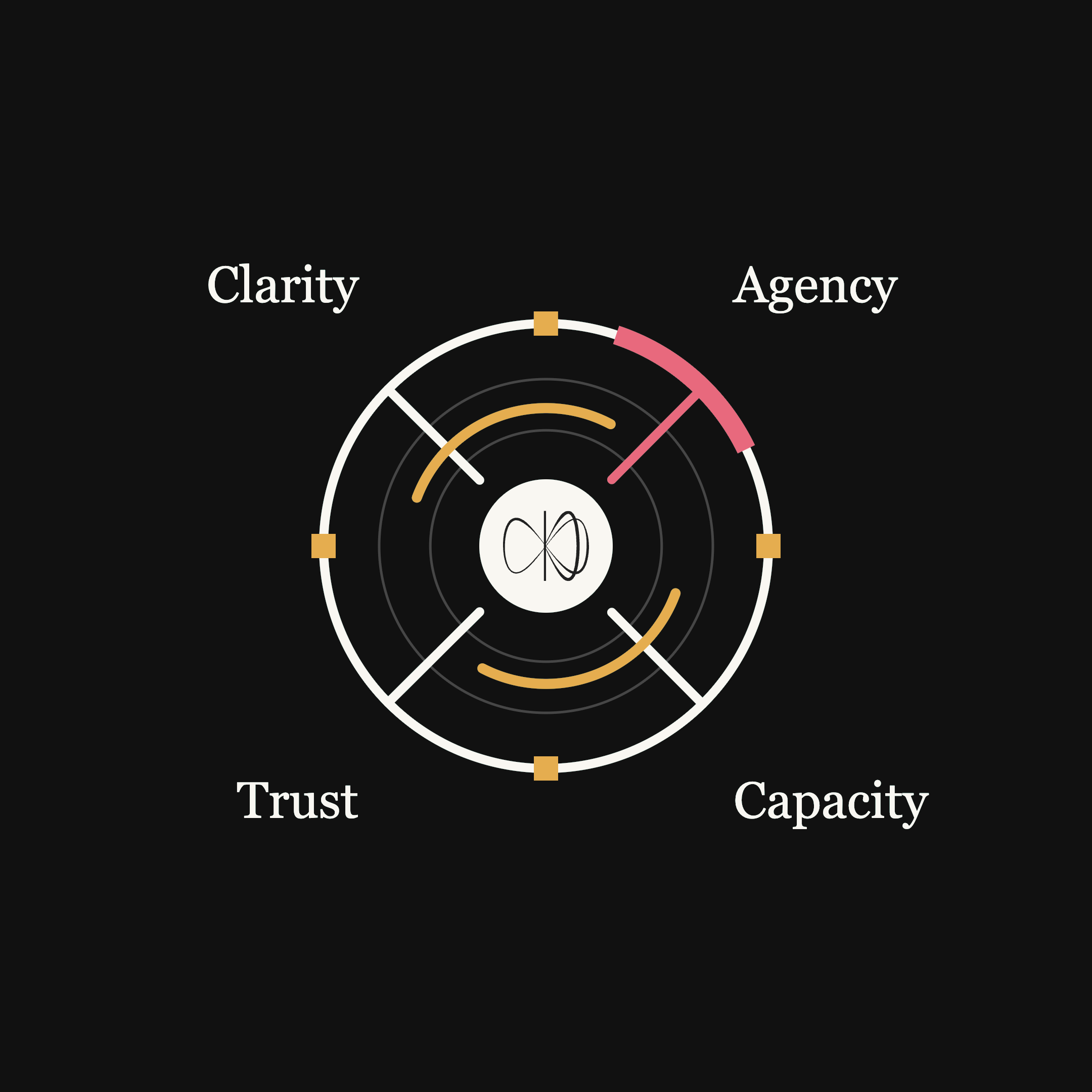
Four conditions determine whether change gains momentum or creates drag: Clarity, Trust, Agency and Capacity.
Clarity
Is the change understood, explainable and coherent in what the organization actually does? Clarity is not achieved when a strategy has been communicated. A leader who can repeat the strategy is not necessarily ready to explain a difficult decision, and a manager who has received the talking points is not necessarily equipped to answer the second question. People need to understand what is changing and why, and that understanding has to survive challenge. It also has to stay coherent in what the organization does next: the next business plan, the next policy, the priorities given to teams.
Agency
Does the organization make the change possible? Understanding what needs to change does not mean people are able to do it. Decision rights, incentives, performance measures, policies and escalation routes all tell people what the organization really expects of them. A manager may understand and believe in the new direction but still be measured against an old target. A team may be expected to move faster while every significant decision still requires escalation. If the organization asks for one behavior and rewards or enables another, the system usually wins.
Capacity
Can the organization absorb what it is asking people to do? The same managers may be carrying an operating-model change, a new technology rollout, cost pressure and business-as-usual delivery at the same time. New tools can add to the load before they take any away. When priorities and trade-offs aren’t explicit, teams make those decisions themselves. They delay, simplify, bypass or quietly drop work.
Trust
What is the organization carrying forward from what happened before? Previous restructures, abandoned programs and promises that disappeared all travel into the next change. Where trust debt has accumulated, the burden of proof rises. People wait for evidence before they commit.
The conditions are interconnected and compounding
These conditions don’t operate independently. An overloaded manager has less capacity to resolve an unclear decision. Credibility suffers when the systems underneath a leader’s explanation make it untrue in practice.
That’s why we resist simple explanations for stalled change. What looks like a communications problem may be an agency problem. What looks like resistance may be overload. What looks like cynicism may be the accumulated weight of what came before. We look for the conditions creating the behavior, not just the behavior itself.